We may earn a commission when you buy through links on this page, at no extra cost to you. As an Amazon Associate we earn from qualifying purchases.
AeroPress vs French press comes down to how many people you brew for and what you want in the cup. Buy the AeroPress if you make one mug at a time and like a clean, grit-free cup in about two minutes. Buy a French press if you brew for two or more, want a heavier body and don’t mind a four-minute steep and a messier cleanup. Our pick for one person is the AeroPress Original; for a household, the Bodum Chambord 34 oz.
Most comparisons stop at taste. This one also lines up the makers’ own brewing instructions side by side, works out what “8 cups” really means on a French press, and covers a difference most guides skip: the paper filter in an AeroPress holds back the coffee oils that raise LDL cholesterol, and a French press’s metal mesh doesn’t.
How we chose
We did not run a lab test. We compared the manufacturers’ published instructions and specs (AeroPress and Bodum), the Amazon listings and their rating counts, and peer-reviewed research on unfiltered coffee. Every number below comes from one of those sources, listed at the end with the date we checked them.
AeroPress vs French press at a glance
| AeroPress Original | AeroPress Original XL | Bodum Chambord 34 oz | |
|---|---|---|---|
| Capacity | 10 oz | 20 oz (2-4 cups) | 34 oz (1 L) |
| Grind (maker’s advice) | Medium-fine | Medium-fine | Coarse only |
| Water temperature | 175°F dark roast, 185°F medium/light | Same as Original | 198-205°F (92-96°C) |
| Steep time | About 30 seconds, then press | About 30 seconds, then press | 4 minutes |
| Filter | Paper micro-filter (50 included) | XL-size paper filters only | Stainless steel mesh |
| Body material | Tritan, BPA-free | Polypropylene + Tritan carafe | Borosilicate glass, steel frame |
| Amazon rating (Oct 2026) | 4.6/5, 26,400+ ratings | Not checked | 4.6/5, 28,700+ ratings |
How each brewer works
Both are immersion brewers: the grounds sit in the water instead of having water drip through them. The difference is what happens next.
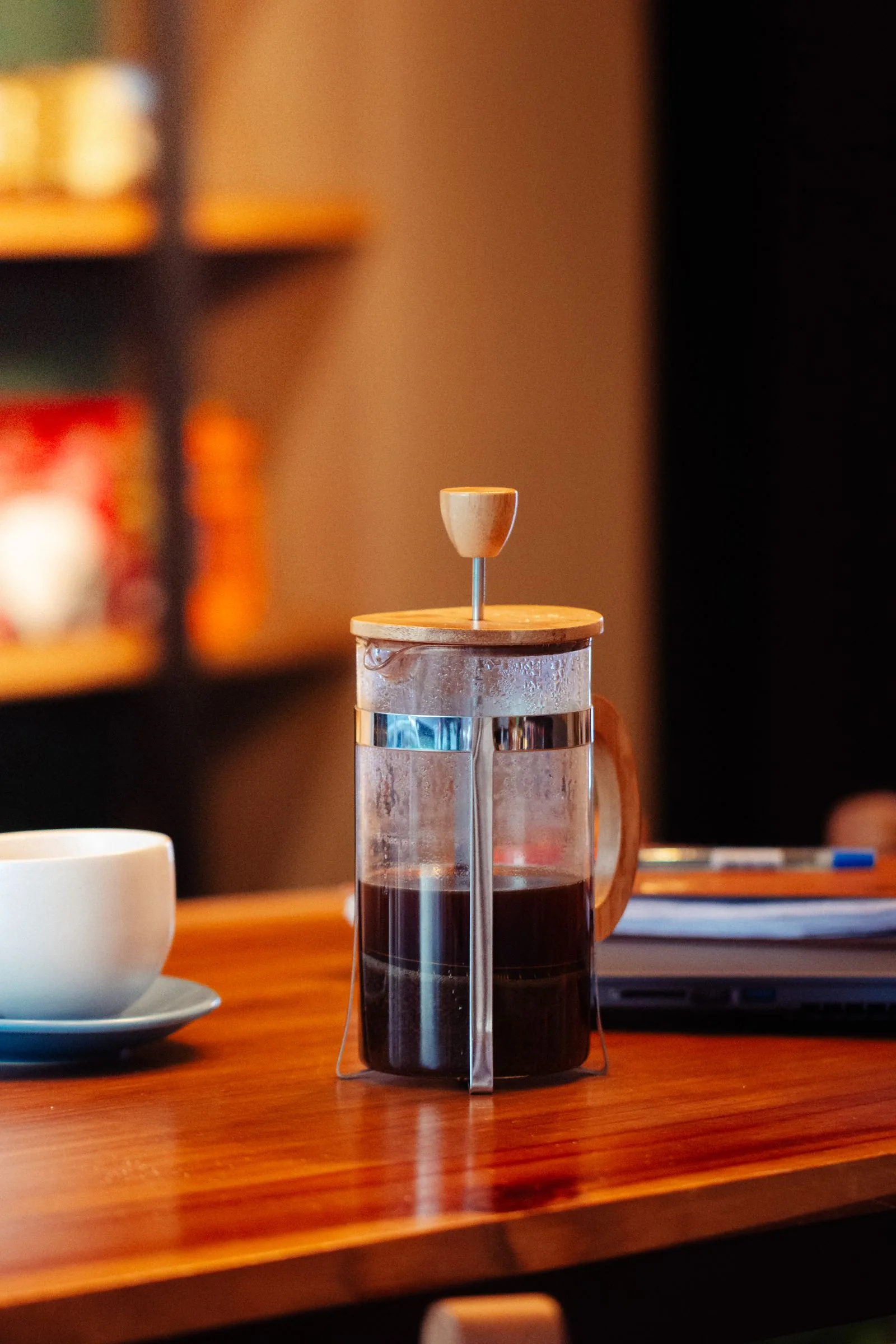
A French press steeps coarse grounds for about four minutes, then a steel mesh plunger pushes them to the bottom. Bodum’s instructions call for one rounded tablespoon (or one Bodum scoop) of coarse coffee per 4 oz of water, water just off the boil at 92-96°C, and at least four minutes before you press. The mesh lets fine particles and coffee oils through, which is where the heavier body and the bit of sludge at the bottom of the cup come from.
The AeroPress uses a shorter steep and finer grounds, then you push the plunger and air pressure forces the coffee through a paper micro-filter. AeroPress’s help center recommends a medium-fine grind and 175°F water for dark roasts, 185°F for medium and light roasts. The Amazon listing sums up the routine: add coffee and water, wait 30 seconds, then press. Cleanup is popping the compressed puck of grounds into the trash and rinsing the plunger.
Because the AeroPress brews with cooler water and a shorter contact time, you need a finer grind to get enough extraction. That makes your grinder matter more than the brewer. If you are still buying pre-ground coffee, a French press is more forgiving with a coarse supermarket grind, while an AeroPress pairs best with a burr grinder (see our manual coffee grinder picks).
What “8 cups” really means on a French press
Bodum sells the 34 oz Chambord as an 8-cup press, but its own listing defines a cup as 4 oz. Most people drink 8-12 oz per mug, so in practice the 34 oz press makes two to three full mugs, and less once you leave the inch of headroom Bodum asks for. The AeroPress Original holds 10 oz, which is one mug. The XL holds 20 oz, which AeroPress rates at 2-4 cups.
That gives a simple rule: one drinker, the Original; two drinkers who want one brew, the XL or a French press; three or more, or anyone who wants a second cup without brewing again, the French press.
The filter difference: body vs cholesterol
Coffee beans contain oily compounds called diterpenes, mainly cafestol and kahweol. Research from Wageningen University found that cafetière (French press) coffee is rich in them, while paper-filtered coffee has negligible amounts. In a six-month trial in that work, volunteers drinking 0.9 liters of French press coffee a day had LDL cholesterol about 9% higher than those drinking filtered coffee. A 1991 study found the cholesterol-raising factor in boiled coffee does not pass a paper filter.
A 2025 Swedish study measured French press coffee at roughly 90 mg of cafestol per liter, against a median of 12 mg per liter for home-brewed paper-filtered coffee. The AeroPress uses a paper filter by default; AeroPress itself says its paper filters keep out the oils, while its optional stainless steel filter lets them through.
For most people with normal cholesterol, a cup or two of French press coffee is not the issue the study volumes suggest, since those trials used close to a liter a day. If you have high LDL or have been told to watch your cholesterol, the paper filter is a concrete reason to choose the AeroPress, and worth raising with your doctor. This is not medical advice.
AeroPress Original: best for one mug at a time
Who it’s for: solo coffee drinkers, office use, travel and camping, and anyone who wants espresso-style concentrate for a homemade latte (our café latte recipe works with it).
Skip it if: you regularly brew for two or more, or you hate buying filters.
- Pro: about two minutes from adding water to drinking, by the maker’s description.
- Pro: paper micro-filter gives a grit-free cup and holds back cafestol.
- Pro: Tritan body is BPA-free and shatter-resistant; the listing gives the weight as 6.4 oz, so it travels well.
- Pro: fast cleanup; the grounds come out as a compact puck.
- Con: 10 oz capacity means one mug per press.
- Con: paper filters are an ongoing purchase (50 come in the box).
- Con: needs a medium-fine grind, so coarse pre-ground coffee gives a weak cup.
It carries a 4.6/5 average from 26,400+ Amazon ratings (October 2026) and a one-year warranty from AeroPress.
AeroPress Original XL: the AeroPress for two
Who it’s for: couples or two-mug drinkers who prefer the AeroPress cup but don’t want to press twice.
Skip it if: you travel with your brewer or already own standard AeroPress filters.
- Pro: 20 oz capacity, which AeroPress rates at 2-4 cups.
- Pro: comes with a 20 oz Tritan carafe to press into.
- Pro: top-rack dishwasher safe and BPA-free, per AeroPress.
- Con: uses XL-only filters; AeroPress says they cost more per filter than the standard size because they are made in smaller runs.
- Con: at 7.6 inches tall it is far less portable than the Original.
Bodum Chambord 34 oz: best French press for a household
Who it’s for: two or three coffee drinkers, people who like a full-bodied, oily cup, and anyone who wants zero filter waste.
Skip it if: you want grit-free coffee, are watching your cholesterol, or need something that survives a backpack.
- Pro: 34 oz (1 liter) borosilicate glass carafe, two to three real mugs per brew.
- Pro: reusable stainless steel mesh filter, nothing to restock.
- Pro: forgiving with coarse pre-ground coffee, so a grinder is optional.
- Pro: made in Bodum’s factory in Portugal, a design in production since the 1950s.
- Con: fine sediment in the last sips; Bodum warns that fine grinds can clog the filter and build pressure.
- Con: glass can break; Bodum says to stir with a plastic or wooden spoon because metal can chip it.
- Con: on most finishes only the glass, plunger and filter are dishwasher safe; the frame and lid are hand wash.
It holds a 4.6/5 average from 28,700+ Amazon ratings (October 2026). For beans that suit it, see our best coffee for French press guide.
Which one should you buy?
- One person, home or office: AeroPress Original.
- Travel, camping, a desk drawer: AeroPress Original. It is light and shatter-resistant, while the Chambord is glass.
- Two people, one brew, clean cup: AeroPress Original XL.
- Two or three people, heavy body: Bodum Chambord 34 oz.
- No grinder, pre-ground coffee only: French press; it is built for a coarse grind.
- High LDL cholesterol or told to limit unfiltered coffee: AeroPress with paper filters.
- Want espresso-style shots for milk drinks: AeroPress. A French press can’t concentrate coffee the same way.
FAQ
Is AeroPress coffee stronger than French press coffee?
It can be, but strength depends on your dose and how much water you add. The AeroPress is often brewed as a concentrate and topped up with hot water, while a French press brews at drinking strength. Body is the clearer difference: French press coffee is heavier and oilier because the mesh lets oils and fines through.
Can I use a French press grind in an AeroPress?
You can, but with the AeroPress’s short steep a coarse grind under-extracts and tastes thin. AeroPress recommends medium-fine. If coarse is all you have, steep longer before you press.
Is French press coffee bad for cholesterol?
Studies show unfiltered coffee, including French press, raises LDL cholesterol when people drink a lot of it, because cafestol passes through a metal filter and is held back by paper. The trials used around 0.9 liters a day. If cholesterol is a concern for you, ask your doctor and consider a paper-filtered method.
Which is easier to clean?
The AeroPress. You push the grounds out as a puck and rinse. A French press leaves wet grounds in the carafe, and Bodum says to unscrew and clean the filter assembly after each use.
Can I make cold brew in either?
Yes. AeroPress lists cold brew and iced coffee among its uses, and a French press works for overnight cold brew: steep coarse grounds in the fridge, then press.
If you mostly drink one mug and want the cleanest cup, start with the AeroPress Original. If your kitchen makes a pot for several people every morning, the Chambord does that job with no filters to buy.
Sources
Checked October 27, 2026.
- AeroPress Help Center, Brewing (grind size, 175°F/185°F water): help.aeropress.com/en-US/articles/brewing-33631
- AeroPress, Original XL product page (20 oz, 2-4 cups, 7.6″ H x 4.6″ W, XL filters, dishwasher top rack, paper vs steel filter oils): aeropress.com/products/aeropress-coffee-maker-xl
- Amazon listing ASIN B0047BIWSK, AeroPress Original (10 oz, 6.4 oz weight, Tritan, 50 filters, 1-year warranty, 4.6/5 from 26,406 ratings)
- Amazon listing ASIN B0C6NGDLLP, AeroPress Original XL
- Amazon listing ASIN B00008XEWG, Bodum Chambord 34 oz (1 L, model 1928-16, borosilicate glass, Portugal, dishwasher note, 4.6/5 from 28,711 ratings)
- Bodum, Chambord product page and instructions (1 scoop per 4 oz, 92-96°C, 4 minutes): bodum.com/us/en/1928-224-chambord
- Bodum 1928-16US4 user guide (coarse grind only, plastic spoon, clean filter after use): manuals.plus
- Urgert R., Health effects of unfiltered coffee, Wageningen University (French press diterpenes, LDL +9% after 6 months at 0.9 L/day): research.wur.nl
- van Dusseldorp M. et al., Cholesterol-raising factor from boiled coffee does not pass a paper filter, 1991: pubmed.ncbi.nlm.nih.gov/2029499
- Cafestol and kahweol concentrations in workplace machine coffee compared with conventional brewing methods, 2025 (French press ~90 mg/L cafestol, paper-filtered median 12 mg/L): sciencedirect.com